

2025.06.16
When reporters visited the National Innovation Center for Advanced Intelligent Home Appliances (hereinafter referred to as the "National Innovation Center") located in Laoshan District, Qingdao recently, staff were busy among various testing instruments, exploring new application methods of the next-generation AI sensing chip to serve more intelligent home appliance scenarios.
Qingdao Galaxy Edge Technology Co., Ltd., incubated by the National Innovation Center, launched the new-generation edge-side AI sensing chip RC705 in June this year. Unlike most artificial intelligence technologies that rely on remote cloud control, this chip integrates built-in AI control and adaptive frequency conversion algorithms, enabling it to independently generate and execute optimal control strategies, thus providing strong driving force for the development of intelligent home appliances and service robots.
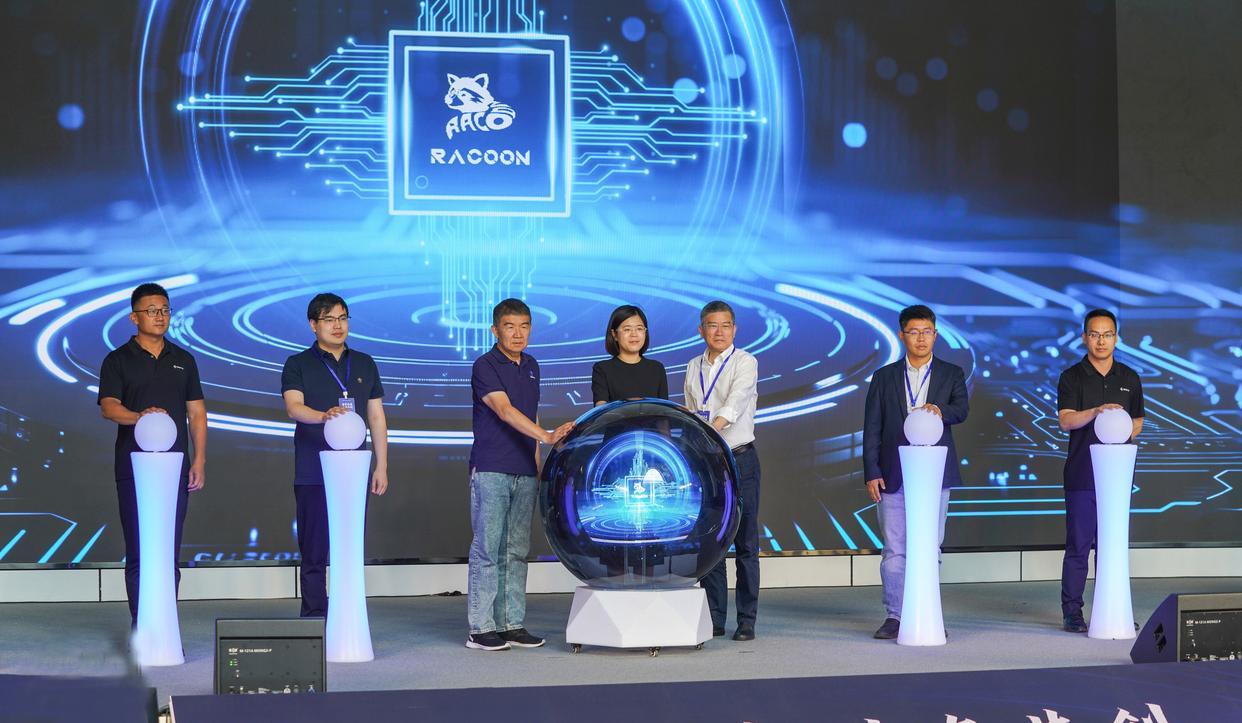
Scene of the Launch Ceremony for the Edge-Side AI Sensing Chip RC705. (Photo provided by the interviewee)
"This chip has enormous application potential in the intelligent home appliance sector. For instance, when used in refrigerators, it can recognize the types of food ingredients and optimize fresh-keeping strategies; when applied to washing machines, it can accurately identify clothing materials and automatically match the optimal washing program; and when integrated into range hoods, it supports contactless gesture control to enhance convenience," introduced Gui Zhihui, Deputy General Manager of the National Innovation Center (NIC).
Currently, artificial intelligence is accelerating its empowerment across all industries. As a traditional manufacturing sector, the home appliance industry is undergoing an upgrade of its underlying technical architecture. Chips, sensors, independent algorithms, large models, and other technologies are driving home appliances toward high-endization and intelligence. "We have established 9 open laboratories covering intelligent home appliance chips, smart sensing, large-model software capabilities, and other areas, and are cooperating closely with several representative local home appliance enterprises," said Gui Zhihui. He added that the NIC possesses strong technical R&D and market-oriented service capabilities in fields such as home appliance vertical large models and home appliance/industrial chips, and will contribute more to the digital and intelligent transformation of traditional industries.
Qingdao is a major hub for home appliance manufacturing in China, home to leading enterprises including Haier, Hisense, and Aucma. With the support of artificial intelligence technology, the local home appliance industry has gained broader development space, and the intelligence level of its products has achieved leapfrog improvement.
In the exhibition hall of Aucma Group, reporters saw the new air-cooled frost-free inverter chest freezer. According to the person in charge of the enterprise's R&D department, relying on AI technology, the product is equipped with a new-generation intelligent air-cooled module and intelligent defrosting technology, enabling fully automatic defrosting. Through a multi-dimensional air curtain, cold air uniformly covers every corner of the refrigerated space. Meanwhile, the intelligent inverter compressor can flexibly adjust its operating frequency, automatically adapting the internal temperature to changes in room temperature to maintain a constant temperature.
In exploring new retail scenarios, Aucma has launched a variety of products based on AI intelligent recognition technology, such as horizontal smart vending cabinets, smart retail display cabinets, and performance monitoring display cabinets. The smart retail display cabinet adopts dual recognition of "AI vision + gravity assistance," achieving a product recognition rate of over 99% and completing checkout in as fast as 3 seconds.
The empowerment of the home appliance industry by artificial intelligence is reflected not only in product upgrading and replacement but also in reshaping the entire process of enterprises' R&D, production, and sales, as well as expanding the industry's boundaries.
At Haier's SCO Refrigerator Internet Factory, from raw material entry to intelligent production line dispatching, AI can systematically schedule the production line to realize mixed-model flow production on demand, doubling the production capacity compared to traditional factories. "In the refrigerator quality inspection link, AI vision technology has improved the detection accuracy from 0.1 millimeters to 0.01 millimeters, driving an efficiency increase of approximately 40%," said Yin Dongdong, Director of Process at the factory.
-
21-Day "Long-Lasting Freshness" – Dreame's Ultra-Low Oxygen Fresh-Keeping Refrigerator Debuts Soon2025.11.24
-
Qingdao, Shandong: Artificial Intelligence Propels the Accelerated Intelligent Transformation of the Traditional Home Appliance IndustryQingdao is a major hub for home appliance manufacturing in China, home to several leading enterprises such as Haier, Hisense, and Aucma. With the support of artificial intelligence technology, the local home appliance industry has gained greater development space, and the intelligence level of its products has achieved leapfrog improvement.2025.06.16