

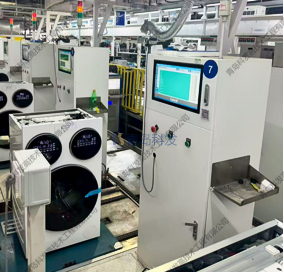
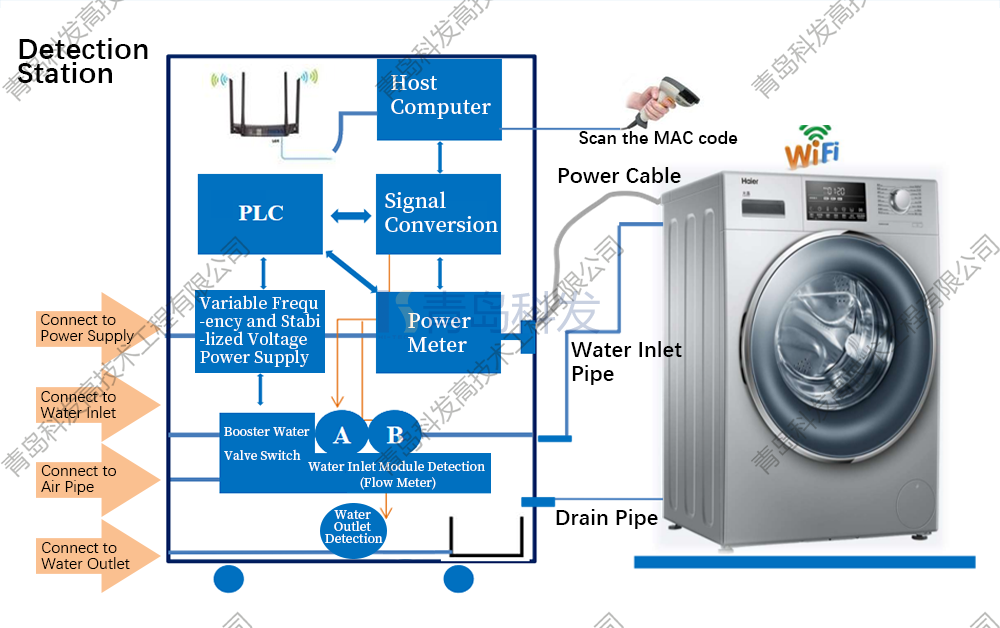
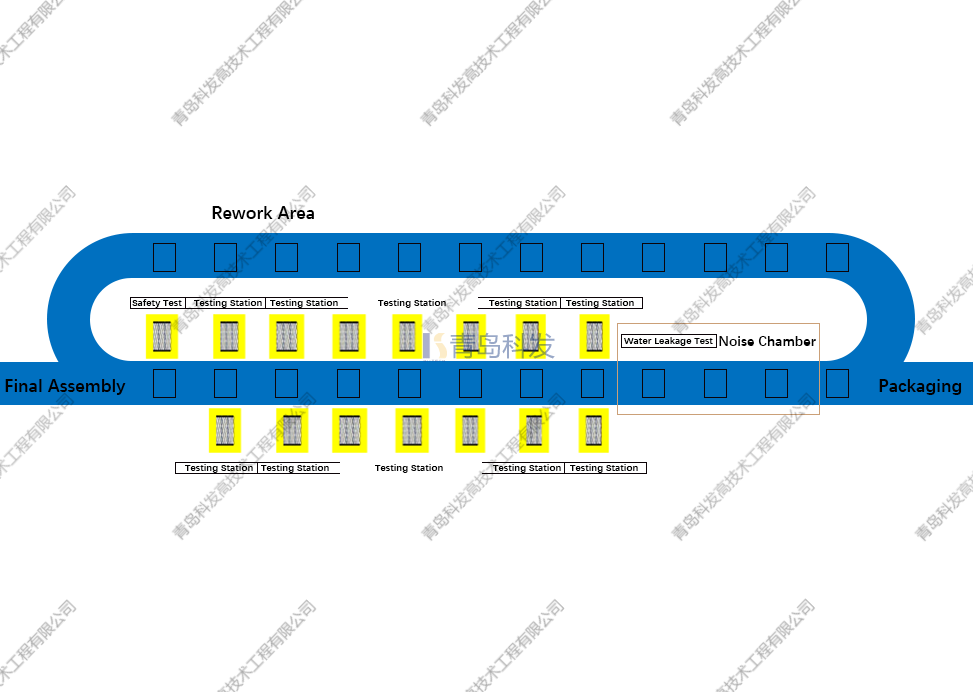

This test system adopts dynamic and static detection modules to monitor parameters including rotating speed and power of washing machines, so as to judge the product quality of washing machines.
1.Data Communication
WiFi and Bluetooth are adopted to realize data interaction between test stations and the main control boards of washing machines. Meanwhile, the equipment can connect to the unified server and cloud service via WiFi for data transmission and model synchronization.
2.Multiple Judgment Modes of the System
The system supports various judgment methods, including comparing data collected by instruments with original data from washing machine main boards; automatic judgment based on curve models of power, flow rate, rotating speed and other parameters; compliance verification by setting parameter criteria such as upper and lower thresholds, temperature differences and operation duration.
3.Production Line Beat Adaptation
The full-automatic testing cycle for a single unit is about 2 minutes and 30 seconds. Standard duration is set for each testing procedure to match the operating rhythm of assembly lines.
4.Automatic System Statistical Reports
The system automatically collects and stores full-range test data including WiFi connection status, safety inspection, power, flow rate and rotating speed. All data is bound with product barcodes and MAC addresses to achieve complete traceability.
5.Supporting Hardware
Equipped with voltmeters, flow meters, power meters, water temperature gauges, barcode scanners and various water inlet/outlet tooling fixtures to support full-item performance testing.
6.Testing Coverage
The system can automatically complete electrical performance, water inlet & drainage, washing, spin-drying, heating, sensor and rotating speed tests. Manual inspection is still required for noise, water leakage and appearance checks.
7.Full-Process Control
The upper computer issues control commands to automatically complete the entire testing process, including power-on, network connection, start/stop of all functions, valve switching and motor operation.
8.Flexible Template Configuration
Parameters such as testing procedures, test items and retest times can be customized to meet the testing requirements of different washing machine models.
9.Centralized Operation and Maintenance Management
All test stations are connected to a unified server. Administrators can remotely maintain test models in a centralized manner without on-site individual debugging.
10.Compatible Test Power Supplies
It supports voltage and frequency specifications such as AC220V/50Hz and AC110V/60Hz, suitable for power supply tests of washing machine models sold in different regions.
11.Cross-Factory Resource Sharing
Relying on cloud services, test templates and test models can be shared among different factories to realize standardized testing implementation.
-
Type
-
Obtain solutions