

The Split-Beam Marine Organism Monitoring Sonar is developed on the basis of multi-frequency broadband sonar (seven center frequencies, 30kHz-1MHz) to meet the needs of acoustic monitoring and evaluation of marine organisms in various scenarios. It can obtain more acoustic scattering echo information of targets.
The split-beam marine organism monitoring sonar uses a four-quadrant transducer to continuously transmit and receive acoustic signals. It measures the target's position through split-beam technology, calculates parameters such as the target's motion trajectory, swimming speed and direction using target tracking technology, and estimates the target strength, target quantity and distribution by analyzing the intensity and structure of echo signals.
According to the characteristics of shallow-sea fishery resources, a broadband split-beam marine organism monitoring sonar with center frequencies of 120 kHz, 200 kHz and 450 kHz is designed. It can improve the accuracy and efficiency of fishery detection, is suitable for application scenarios such as biological resource surveys and fish behavior analysis, and meets the user needs for fishery resource monitoring on various manned and unmanned platforms.
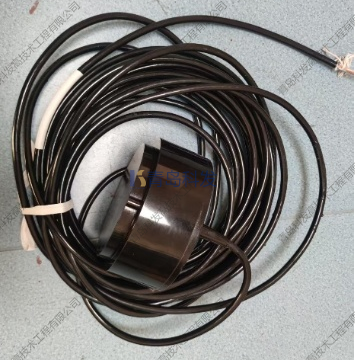
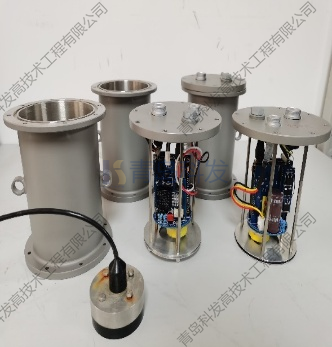
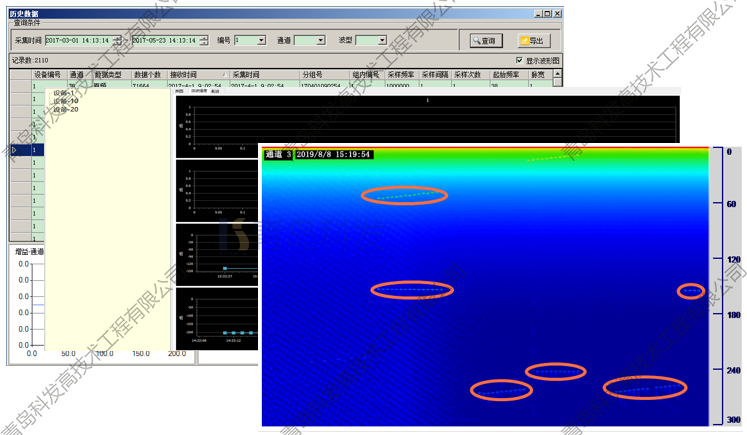
Fig.1 Transducer, Electronic Cabin and Data Analysis Software of Marine Organism Monitoring Sonar
Features
· Broadband technology and split-beam technology
· Capable of target positioning, tracking and distribution evaluation
· Independent intellectual property rights (IPR) for equipment and core algorithms
· Equipped with process data storage capability, supporting data traceback and mining
· Low power consumption, supporting software and hardware function expansion
Technical Specifications
Technical Parameters |
Technical Specifications |
Technical Parameters |
Technical Specifications |
Center Frequency |
120 / 200 / 450 kHz |
Dynamic Range: |
≥80 dB |
Signal Form |
CW/LFM |
Detection Range: |
≥100 m |
Transmission Frequency |
User-selectable, 0.1–30 times per second |
Data Interface: |
Gigabit Network |
Maximum Transmitted Source Level |
≥215 dB |
Weight: |
≤10 kg |
Gain Control |
User-Preset Gain Curve |
Power Supply: |
Direct Current |
Software Functions
The software controls the startup, shutdown and parameter configuration of the sonar via the network. The built-in algorithm module outputs real-time information such as the target's position, quantity, category, swimming direction and speed. The software database automatically stores target status information and displays it on the software interface in real time. In addition, the software reserves a shared data interface, allowing managers to set corresponding access permissions through the remote user login function.
· Target Strength Calibration for Raw Data
· Automatically identify and reduce background noise and intermittent noise
· Target feature extraction, recognition, classification and tracking
· Quantitative analysis of temporal and spatial changes in marine biological resources
· Equipped with functions for sonar parameter setting, real-time data collection and storage, and historical data query and export
· Graphical display of real-time data and real-time log display
Expected Effects
· Multi-dimensional Target Feature Extraction
Extract features such as the echo time-frequency characteristics, motion trajectory, speed, and biological group distribution of targets, and establish a target species feature library.
· Automatic Data Report Generation
When organisms pass through the monitoring section, their occurrence time, depth, movement speed, movement direction, and position are recorded. The algorithm module identifies species based on their behavioral characteristics and acoustic scattering characteristics, and predicts their subsequent behaviors. The final data analysis results are pushed to managers in the form of reports, improving their work efficiency and management level.
· Grasp Target Organisms' Activity Patterns through Long-term Data
Through long-term statistical analysis of data such as the time, quantity, speed, and direction of target organisms passing through the monitoring section, combined with hydrological and meteorological conditions, the activity patterns of target organisms can be grasped to a certain extent.
· More Effective Night Monitoring
Acoustic monitoring technology is not affected by visibility and works 24/7, making it more effective for night monitoring.
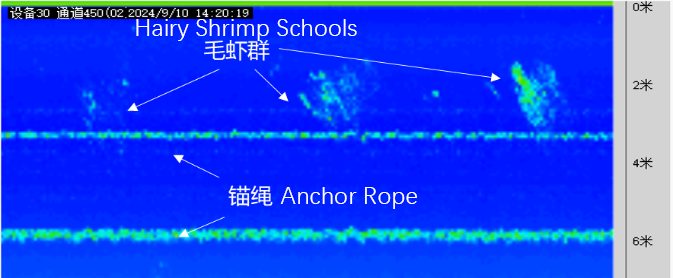
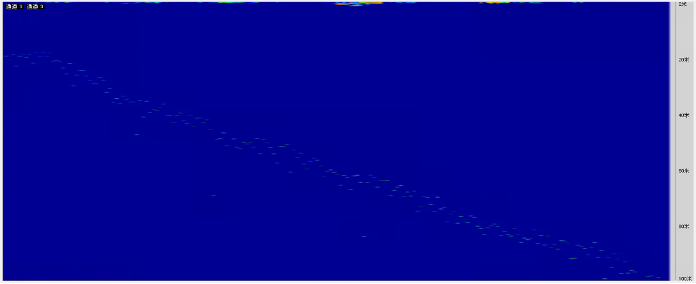
Fig.2 Vertical and Horizontal Monitoring Sonar Images
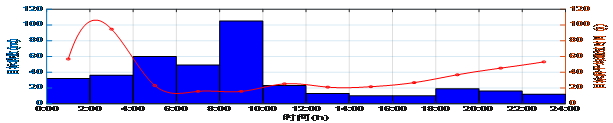
Fig.3 24-Hour Activity of Marine Organisms