

The 3D multi-beam imaging sonar is an advanced underwater acoustic detection device that enables real-time 3D imaging and target recognition of underwater objects. Adopting broadband signal modulation technology, the device reconstructs underwater spatial information at the receiving end through an adaptive beamforming algorithm. It has a field of view of up to 45°×45° and an operating range of ≥50 meters, capable of accurately characterizing the geometric features of underwater objects.
The system mainly consists of a transmitting transducer, a receiving transducer, an electronic cabin, and software. The upper part of the front panel of the electronic cabin is the transmitting transducer, and the lower part is the receiving transducer. The power supply and communication cables are led out from the rear end of the electronic cabin to transmit data to the shore-based computer.
The 3D multi-beam imaging sonar device can significantly improve underwater operation efficiency. It is suitable for application scenarios such as port security and underwater structure inspection, and can meet the user needs for underwater target observation on various manned and unmanned platforms.
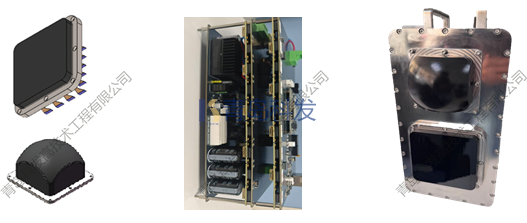
Technical features
· Broadband technology and multi-beam technology
· High-resolution imaging algorithm,presenting complete and detailed images
· Relatively independent functional units,supporting modular customization
· Core algorithms with full independent intellectual property rights(IPR)
· The system features a user-friendly human-machine interface(HMI) with sufficient fault tolerance
Technical specifications
|
Technical Parameters |
Technical Specifications |
Technical Parameters |
Technical Specifications |
Center Frequency |
375 kHz |
Range Resolution |
≤5cm |
Field of View |
45°Í45° |
Maximum Operating Water Depth |
≥ 50m |
Number of Beams |
128*128 |
Weight |
≤30 kg |
Operating Range: |
≥50m |
Power Supply |
Direct Current |
Software Functions
The display and control software controls the operation of the 3D multi-beam imaging sonar, receives echo data, and generates 3D images. Sonar images are displayed in pseudo-color with selectable color modes, and underwater target detection results are presented in 3D form. Three-dimensional characteristic information of underwater targets can be obtained by analyzing beam data.
· Data Communication and Storage
· Sonar Parameter Setting and Status Display
· Raw Data Processing and Display
· 3D Imaging and Display of Underwater Targets
· Sonar Image Analysis and Processing
· Data Query and Export
· Reserved Interfaces for Secondary Development and Software Expansion
Expected Effects
· Real-time Observation of Underwater Environment
It captures the three-dimensional morphology and spatial distribution of floating objects or biological groups in the detection area in real time, assisting users in quickly judging the threat level.
· Dynamic Cumulative Risk Assessment
The system continuously records the spatio-temporal distribution characteristics of targets in three-dimensional space, and analyzes the cumulative effect trend in combination with hydrodynamic models.
· Construction of Underwater Target Feature Library
The system records target information such as size, motion vector, behavior pattern and distribution form for a long time. Based on deep learning algorithms, it establishes an acoustic feature database for targets such as floating objects, plankton and fish.
· All-time Security Situation Awareness
The system has the ability to reconstruct 3D information of underwater targets in turbid waters at night, and can intuitively display the real-time three-dimensional target distribution situation within a 50m radius around the deployment point.