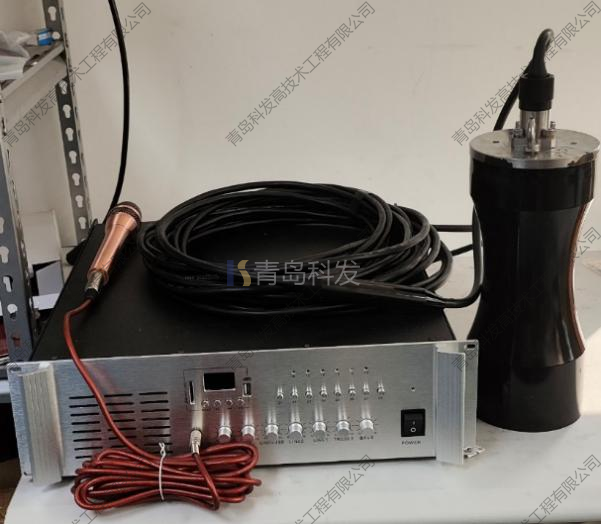

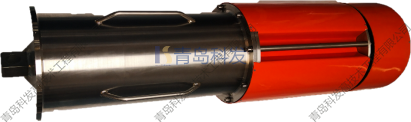
The self-contained sound source uses the display and control software to preset parameters such as the transmitted signal type, duration, interval, and emission time, and generates various types of signal files. These signal files are transmitted to the self-contained sound source device terminal via an Ethernet cable. After the self-contained sound source is launched underwater and lowered to the operating depth, it independently transmits various regular or irregular signals according to the preset signal emission time. Regular signals can be configured by presetting parameters including signal type, signal frequency, signal pulse width, signal emission interval, and emission count; irregular signals can be generated through frequency point sequence arrays or received acoustic signal data. The self-contained sound source generates transmitted signals in accordance with the instructions in the preset files. Through isolation, amplification, and matching by the internal transmitter, the signals are sent to the transducer terminal, which drives the transmitting transducer to convert electrical signals into acoustic signals, completing the emission of various sound source signals.
+86 0532-80918305
| Operating Bandwidth | 2kHz - 8kHz |
| Maximum Source Level | ≥ 190dB |
| Maximum Transmitting Power | ≥ 600W |
| Transmitted Signal Types | CW, LFM, FSK, etc. |
| Transmitting Transducer Angle | Omnidirectional horizontally, ±40° vertically |
| Signal Sampling Rate | 128kbps |
| Signal Data Precision | 16 bits |
| Operating Time | ≥ 48h |
| Control Interface | 1000M Ethernet |
| Operating Depth | ≥ 300 meters |